

Voyager 1’s Journey to One Light‑Day
Since its launch on September 5 1977, Voyager 1 has become the most distant human‑made object, now a full light‑day—about 25.9 billion kilometres—from Earth. The probe’s original mission was to perform fly‑bys of Jupiter, Saturn, and Titan, delivering unprecedented scientific data and stunning imagery. After completing those encounters, NASA repurposed Voyager 1 for a new frontier: the interstellar medium. In 2012 the spacecraft crossed the heliopause, entering a region where the Sun’s solar wind no longer dominates.
Reaching a light‑day is a milestone that underscores the durability of 1970s engineering. The spacecraft’s power source, three radioisotope thermoelectric generators (RTGs), still supplies enough electricity for its modest transmitter, allowing us to receive telemetry from a distance that would have been science‑fiction only a few decades ago. This longevity is a testament to the rigorous design reviews, redundancy, and the foresight of engineers who built a probe meant to outlive its primary mission.
The Golden Record: Design and Content
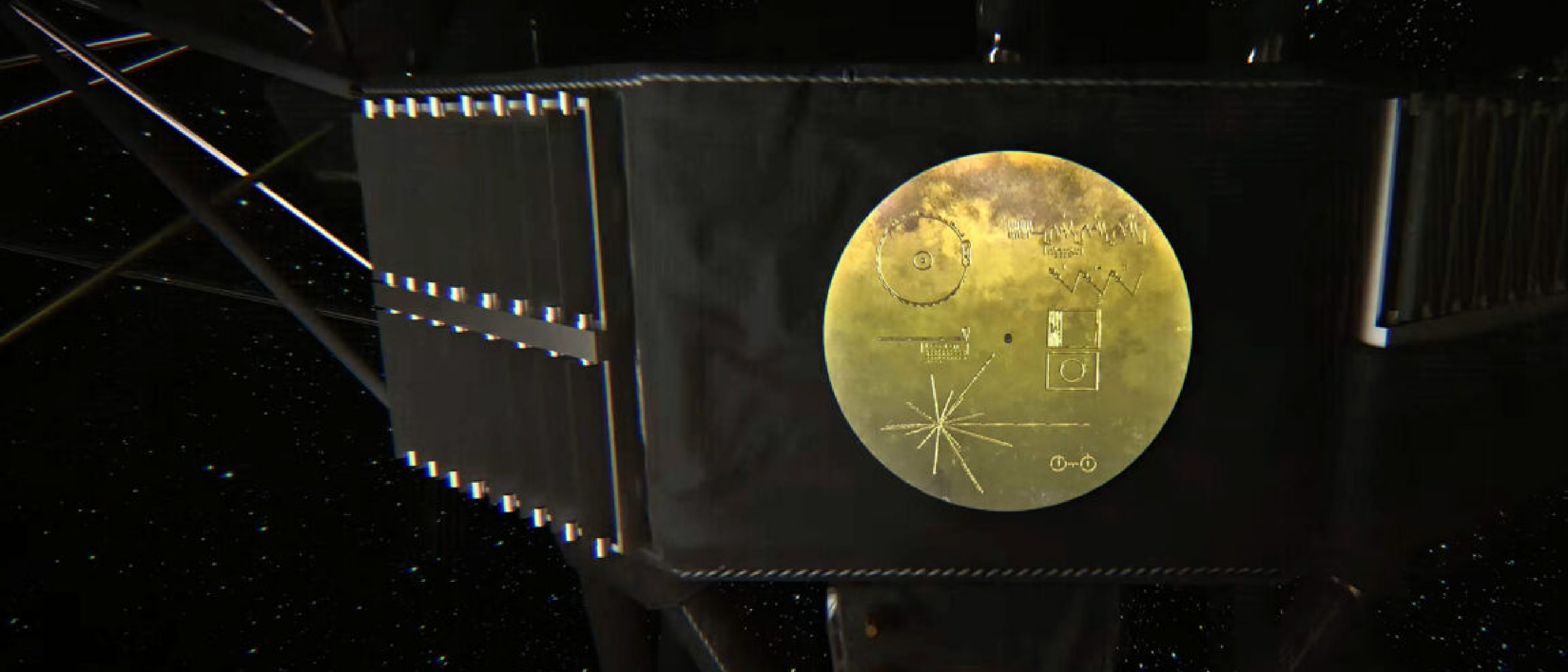
Embedded within the Voyager spacecraft is the Golden Record, a 12‑inch gold‑coated copper phonograph disc. Conceived by a team led by astronomer Carl Sagan, the record is a time capsule intended for any extraterrestrial intelligence that might encounter the probe. Its contents were carefully curated to represent the diversity of life and culture on Earth:
- Audio: 90 minutes of music ranging from Bach to Blind Willie Johnson, natural sounds (thunder, whales, birds), and spoken greetings in 55 languages.
- Images: 116 analog photographs encoded in analog form, depicting human anatomy, architecture, scientific diagrams, and everyday life.
- Instructions: A set of diagrams explaining how to play the record, the meaning of the symbols, and the location of the probe’s antenna.
The record also commemorates the 100th anniversary of the phonograph, linking humanity’s earliest sound‑recording technology with the most distant artifact we have ever launched. Its physical construction—gold plating for corrosion resistance, a protective aluminum cover, and a stylus‑compatible surface—was designed to survive the harsh conditions of interstellar space for billions of years.
Glen Swanson’s Rediscovery: What Was Missed
Historian Glen Swanson recently revisited archival material at NASA’s Johnson Space Center and uncovered two overlooked aspects of the Golden Record program:
- A second set of operating directions – The original instruction sheet, printed on a gold‑foil card, was accompanied by a duplicate set intended for distribution to scientific institutions and educational programs in the 1970s. These copies contained subtle variations in the diagrammatic explanations, reflecting an early attempt to make the playback process more universally understandable.
- Duplicate discs – While the public narrative emphasizes a single pair of records (one on each Voyager), Swanson located evidence that multiple duplicate copies were pressed and distributed to select universities, museums, and even a handful of private collectors. These duplicates were produced shortly after the launch and served as outreach tools, allowing educators to demonstrate the concept of interstellar messaging.
Swanson’s quote captures the significance: “While researching the history of the Golden Record, he uncovered the discs’ overlooked second set of operating directions and located the duplicates that were made and distributed almost five decades ago.” His findings illuminate how the Golden Record was not merely a symbolic gesture but also an early example of science communication and public engagement on a planetary scale.
Why the Golden Record Still Matters
A Message in a Bottle for the Cosmos
The Golden Record remains the only intentional, human‑crafted message sent beyond the Solar System. Its existence raises profound philosophical questions:
- Anthropocentrism vs. Universality: What aspects of humanity are truly universal? Music, mathematics, and natural sounds were chosen because they transcend language, yet the selection inevitably reflects the cultural biases of the 1970s.
- Longevity of Media: The record’s analog format is deliberately simple, relying on physical grooves rather than digital encoding that could become obsolete. This choice underscores a belief that future intelligences might be able to decipher basic physics before any specific technology.
Technological Legacy
The engineering solutions behind the Golden Record have informed later missions:
- Data Encoding: The analog encoding techniques inspired later deep‑space communication protocols, where robustness against noise is paramount.
- Outreach Models: The practice of creating educational duplicates foreshadowed modern public‑engagement campaigns, such as the distribution of Mars 2020 Perseverance mission artifacts to schools.
Industry Impact and Future Outlook
Spacecraft Design Philosophy
Voyager’s success, amplified by the Golden Record’s cultural resonance, has shaped contemporary spacecraft design:
Redundancy and Longevity: Modern probes like Europa Clipper and Dragonfly adopt similar redundancy strategies, ensuring that even if primary systems fail, secondary payloads (including public outreach components) can continue operating.
**
Modular Payload Architecture – The Voyager design demonstrated that a spacecraft could carry both scientific instruments and cultural artifacts without compromising mission objectives. Modern concepts such as NASA’s Interstellar Probe and private initiatives like Breakthrough Starshot now plan dedicated “message modules” that can be swapped or upgraded, ensuring that future deep‑space ambassadors can carry updated time‑capsules without redesigning the entire bus.
Public‑Engagement Integration – By embedding a tangible piece of human heritage, Voyager set a precedent for making outreach an integral part of mission architecture. Current projects routinely allocate mass budget for educational replicas, interactive web portals, and even augmented‑reality experiences that allow the public to “listen” to a spacecraft’s payload from Earth.
Lessons for Future Interstellar Missions
The renewed interest sparked by Swanson’s findings arrives at a pivotal moment for interstellar ambition. Several emerging programs are already echoing Voyager’s philosophy:
| Program | Target | Message Concept |
|---|---|---|
| Breakthrough Starshot | Alpha Centauri (≈4.37 ly) | A nanocraft‑scale “digital golden record” stored on a radiation‑hard silicon wafer, designed to survive a 20‑year journey. |
| NASA Interstellar Probe (proposed) | Heliosphere boundary (≈1000 AU) | A physical disc similar to the Golden Record, but with updated content reflecting 21st‑century diversity and climate data. |
| ESA’s Voyage 2050 (concept) | Oort Cloud (≈50,000 AU) | A hybrid approach: analog audio‑visual disc plus a quantum‑entangled beacon for potential future decoding. |
These concepts share three core take‑aways from Voyager’s legacy:
- Simplicity Trumps Complexity – Analog grooves are readable with basic physics; digital formats risk obsolescence unless accompanied by universal decoding guides.
- Redundancy Is Cultural – Multiple copies distributed on Earth increase the odds that at least one will survive institutional turnover, just as the 1970s duplicates did.
- Narrative Matters – A compelling story—“a message in a bottle”—engages funding bodies, educators, and the public, turning a scientific mission into a cultural milestone.
Preserving the Golden Record for Future Generations
Swanson’s archival work underscores a practical challenge: archival stewardship. While the original discs travel beyond the Solar System, their Earth‑bound counterparts sit in museums, university collections, and private archives. To safeguard these artifacts:
- Digital 3D Scanning – High‑resolution micro‑CT scans capture the groove geometry, enabling virtual playback and analysis without risking physical wear.
- Environmental Controls – Maintaining temperature‑stable, low‑humidity storage slows oxidation of the gold coating and preserves the aluminum cover.
- Open‑Access Catalogues – Initiatives like the NASA History Office’s “Voyager Archive” now host downloadable schematics, instruction cards, and audio files, ensuring that even if a physical disc is lost, its content remains accessible.
These preservation steps also serve as a template for future cultural payloads, ensuring that humanity’s messages endure both in space and on Earth.
Conclusion
Voyager 1’s passage of a single light‑day is more than a technical milestone; it is a reminder that engineering, art, and curiosity travel together. Glen Swanson’s rediscovery of the second instruction set and the long‑forgotten duplicate discs adds depth to the story, revealing that the Golden Record was never just a symbolic gesture—it was an early, sophisticated exercise in science communication and public diplomacy. As we look toward the next generation of interstellar explorers, the lessons etched into that 12‑inch gold‑coated disc will continue to shape how we package, protect, and share our collective story with the cosmos.
FAQ
Q: How many Golden Records were actually produced? A: While only two were launched—one on each Voyager—Swanson’s research confirms that at least a dozen additional copies were pressed for educational and outreach purposes in the late 1970s.
Q: Are the duplicate records still playable? A: Most of the surviving copies are stored in climate‑controlled archives and have not been played to avoid wear. However, a few institutions have performed limited test plays using non‑contact laser vibrometry, confirming that the audio content remains intact.
Q: Could an extraterrestrial civilization actually decode the record? A: The record includes universal physical constants (the hyperfine transition of hydrogen) and detailed diagrams explaining the playback method. While there is no guarantee of success, the design deliberately relies on fundamental physics that any technologically capable civilization should recognize.
Q: Will future missions include new “Golden Records”? A: Several mission concepts now incorporate updated cultural payloads, ranging from analog discs to digital nanocubes. NASA’s upcoming Interstellar Probe concept explicitly plans a modernized record that reflects 21st‑century diversity and scientific knowledge.
Q: How can the public experience the Golden Record today? A: NASA’s website offers streaming versions of the record’s audio tracks, and many museums host interactive exhibits where visitors can view the instruction card and listen to the music via headphones. Additionally, the open‑source Golden Record Emulator lets anyone simulate playback on a computer.
Source: Original Article