





Overview – A New Take on Portable Power
Nimble’s SharePower arrives at a moment when the market is saturated with single‑unit power banks that promise higher capacities but often force users to carry multiple devices for group travel. The SharePower’s core proposition is simple yet bold: a 10 000 mAh battery that can be magnetically split into two independent 5 000 mAh packs, each with its own USB‑C port. The design targets travelers, families, and anyone who regularly needs to keep more than one device alive without lugging around a bag of chargers.
Sam Rutherford’s Engadget review awards the device an 8.6 / 10, praising its innovative form factor while noting a handful of practical compromises. The pack measures 3.1 × 2.8 × 1 inches and weighs 7.6 oz—roughly the size of a deck of cards—making it easy to slip into a pocket or small daypack. Its shell is molded from 100 % recycled plastic, aligning the product with the growing demand for environmentally conscious accessories.
Technical Breakdown
Physical Design and Build
- Magnetic Split Mechanism – Two halves latch together via a set of embedded magnets. When separated, pogo pins automatically equalize the charge level, ensuring both halves start from the same state of charge.
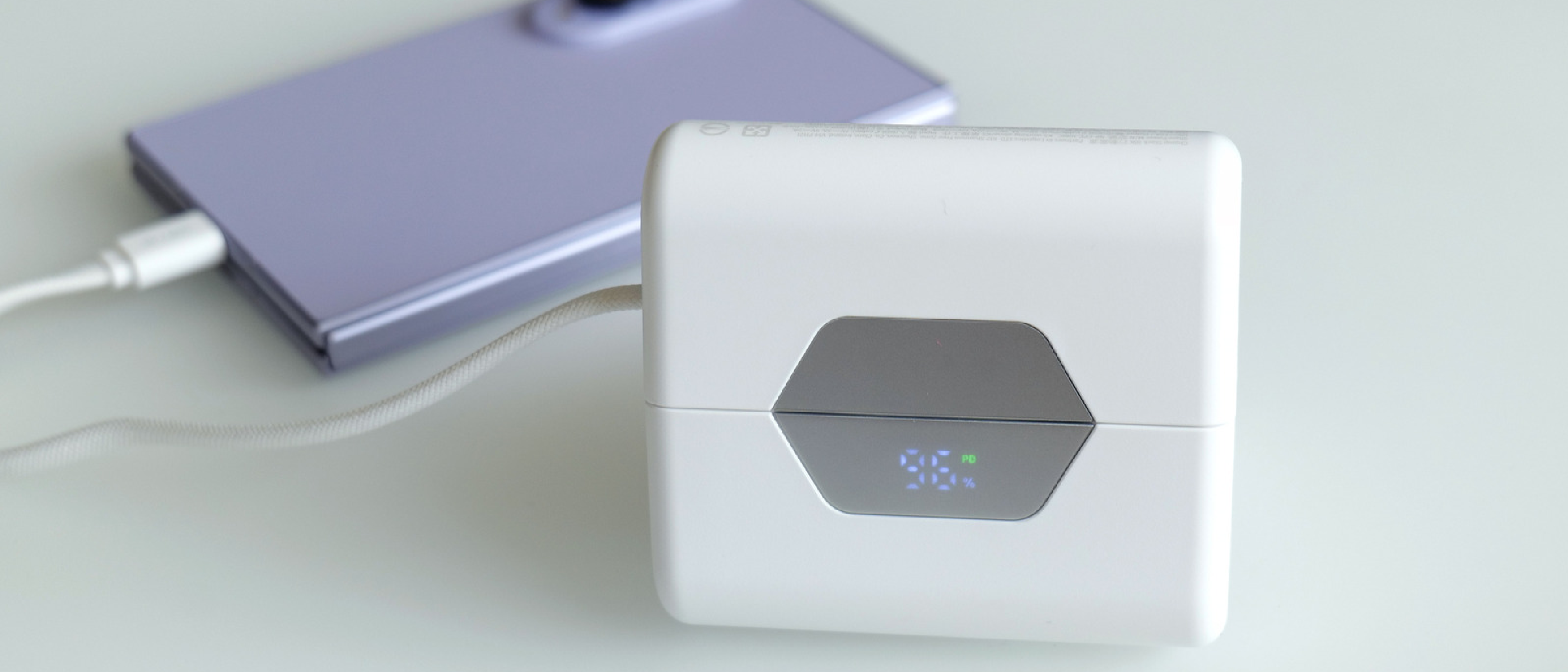
- Integrated Carrying Strap – The strap doubles as a captured USB‑C cable, reducing the need for an extra cord in many scenarios. A spare USB‑C cable is also included in the box.
- Digital Power Readout – Press a button on the decorative hexagon to reveal a small LCD that displays the combined charge percentage. Four hidden LEDs on each half provide a quick visual cue for charge status.
- Ports – When assembled, the unit offers three USB‑C ports (two on one half, one on the other). Split, each half retains a single USB‑C port.
Power Delivery
- Total Capacity – 10 000 mAh (5 000 mAh per half when split). This is enough for a full charge on most flagship smartphones and roughly 80 % of a Nintendo Switch 2 battery.
- Output – Up to 35 W total when assembled, distributed across three ports. In practice, the maximum single‑device output measured at 20 W, which aligns with the Power Delivery 3.0 profile common on modern laptops and tablets.
- Charging the Pack – The magnetic connection allows both halves to charge together, while the pogo pins keep the cells balanced. The device supports up to 20 W input via any of its USB‑C ports.
Materials and Sustainability
The 100 % recycled‑plastic enclosure not only reduces the carbon footprint but also feels sturdy in hand. Rounded edges and a compact footprint mitigate the risk of accidental drops, a frequent concern for travelers.
Real‑World Use Cases
Group Travel
Imagine two friends on a weekend road trip. One needs to keep a phone alive for navigation, the other is gaming on a Switch 2. By snapping the SharePower in half, each traveler receives a dedicated 5 000 mAh pack, eliminating the “who gets the charger?” dilemma. When the day ends, the halves magnetically rejoin, allowing a single charge session.
Remote Work and Mobile Offices
Freelancers who work from cafés often jug
gle between a laptop, phone, and tablet. The SharePower’s three-port configuration (when assembled) lets them power all three simultaneously, reducing the need for multiple wall adapters. The built-in cable further streamlines the setup, eliminating the hassle of tangled cords in a crowded workspace.
Emergency Preparedness
For those who prioritize redundancy, the SharePower’s split design offers a unique advantage. In scenarios like power outages or natural disasters, the ability to distribute power between two independent units ensures that critical devices—such as phones or medical equipment—remain operational even if one half is misplaced or damaged.
Criticisms and Trade-Offs
While the SharePower’s innovation is undeniable, it isn’t without its compromises. The most glaring issue is the magnetic connection’s fragility. The halves can detach with minimal force, such as a sharp tug or accidental drop, which could be problematic in high-movement environments like hiking or public transit. Users may need to handle the device with extra care to avoid unintended separation.
The captured USB-C cable, while convenient, introduces a potential point of failure. If the cable wears out or breaks, repairs could be difficult or impossible without replacing the entire unit. Additionally, the cable’s dual role as a carrying strap means it may endure more stress than a typical charging cable, accelerating wear over time.
Performance-wise, the 20W single-device output falls short of the advertised 35W total capacity. While this is sufficient for most smartphones and tablets, users with higher-power devices—such as laptops or gaming handhelds—may find the charging speeds slower than expected. The lack of wireless charging is another omission, though this is understandable given the split design.
Finally, the price point is a consideration. While not explicitly stated in the review, the SharePower is positioned as a premium product, likely costing more than standard 10,000mAh power banks. For budget-conscious buyers, the added convenience of the split design may not justify the higher cost.
Comparison to Alternatives
The SharePower occupies a niche between traditional power banks and multi-port charging hubs. Here’s how it stacks up against common alternatives:
Single-Unit Power Banks (e.g., Anker PowerCore, Zendure SuperTank):
- Pros: Higher capacities (up to 26,800mAh), faster charging speeds, and often lower prices.
- Cons: Bulkier, lack the flexibility of splitting into independent units, and require multiple devices for group use.
Multi-Port Chargers (e.g., RavPower 60W 6-Port Charger, Baseus 100W GaN Charger):
- Pros: Can charge multiple devices simultaneously, often with higher wattage output.
- Cons: Stationary (not portable), require access to a power outlet, and lack the SharePower’s split functionality.
Modular Power Banks (e.g., Zendure SuperTank Pro, HyperJuice Battery Pack):
- Pros: Expandable capacity, high power output, and rugged designs.
- Cons: Typically larger and heavier, with no built-in splitting mechanism.
The SharePower’s closest competitor is arguably the Zendure SuperTank Pro, which offers modular expansion but lacks the magnetic split design. For users who prioritize portability and flexibility, the SharePower’s unique form factor may be worth the trade-offs.
Verdict: Who Is the SharePower For?
The Nimble SharePower is best suited for:
- Travelers and groups who need to share power without carrying multiple devices.
- Remote workers who require a compact, multi-device charging solution.
- Eco-conscious consumers who appreciate the 100% recycled plastic construction.
- Tech enthusiasts who value innovative design and are willing to pay a premium for it.
It’s less ideal for:
- Users with high-power devices (e.g., laptops) who need faster charging speeds.
- Budget shoppers looking for the most cost-effective power solution.
- Those who prioritize wireless charging or rugged durability.
Conclusion
The Nimble SharePower is a clever, well-executed take on portable power, addressing a specific pain point for travelers and groups. Its ability to split into two independent 5,000mAh packs is a standout feature, offering flexibility that traditional power banks can’t match. While the magnetic connection’s weakness and the captured cable’s durability are valid concerns, the overall design and functionality make it a compelling choice for the right user.
Engadget’s 8.6/10 rating reflects its strengths—innovation, portability, and sustainability—while acknowledging the practical trade-offs. If you’re in the market for a power bank that does more than just charge your devices, the SharePower is worth considering.
FAQ
1. How long does it take to fully charge the SharePower?
The SharePower supports up to 20W input, so a full charge from 0% takes approximately 2.5 to 3 hours when using a compatible USB-C charger.
2. Can I charge the SharePower while using it to power other devices?
Yes, the SharePower supports pass-through charging, allowing you to charge the pack itself while simultaneously powering connected devices.
3. Is the SharePower TSA-compliant for air travel?
Yes, the SharePower’s 10,000mAh capacity is well within the TSA’s limit of 100Wh (or ~27,000mAh) for carry-on luggage. However, always check with your airline for specific regulations.
4. What happens if one half runs out of power before the other?
The pogo pins automatically equalize the charge when the halves are reassembled, ensuring both units recharge to the same level.
5. Can I use the SharePower to jump-start a car or power high-wattage devices?
No, the SharePower is designed for USB-C devices only (e.g., phones, tablets, gaming handhelds). It does not support high-wattage outputs required for car jump-starters or larger electronics.
6. How durable is the SharePower?
The 100% recycled plastic shell is sturdy but not ruggedized. It’s best suited for everyday carry and travel rather than extreme conditions. The magnetic connection is the weakest point, so handle with care.
7. Does the SharePower come with a warranty?
Nimble typically offers a 1-year limited warranty on its products, but check the official website or packaging for the most up-to-date terms.
8. Where can I buy the SharePower?
The SharePower is available through Nimble’s official website, Apple’s accessory page, and select retailers like Amazon and Best Buy.
Source: Original Article