

The Evolution of In‑Car Displays
Over the past decade, the automotive interior has transformed from a simple array of analog gauges to a sprawling digital ecosystem. Early digital clusters were modest 7‑inch screens that merely replicated speedometer and fuel‑level data. Today, flagship models from multiple brands sport multiple high‑resolution panels, touch‑enabled infotainment units, and even rear‑seat entertainment walls.
The trend is unmistakable:
- Screen proliferation – dashboards now host three to five distinct displays, each serving navigation, climate control, media, or vehicle diagnostics.
- Size escalation – the central infotainment screen on many premium cars exceeds 15 inches, rivaling a tablet.
- Form‑factor experimentation – curved OLED panels, floating glass modules, and transparent displays are being trialed in concept cars.
Yet, physical size has limits. A larger screen consumes more cabin space, adds weight, and can distract the driver. Moreover, the visual hierarchy of a cluttered cockpit can become confusing, especially when multiple screens vie for attention. This saturation has sparked a pivotal question in the industry: “Do screens in cars represent luxury?” The answer is evolving, and Mercedes‑Benz’s holographic heads‑up display (HUD) is positioned as the next logical step.
How Mercedes‑Benz’s Holographic HUD Works
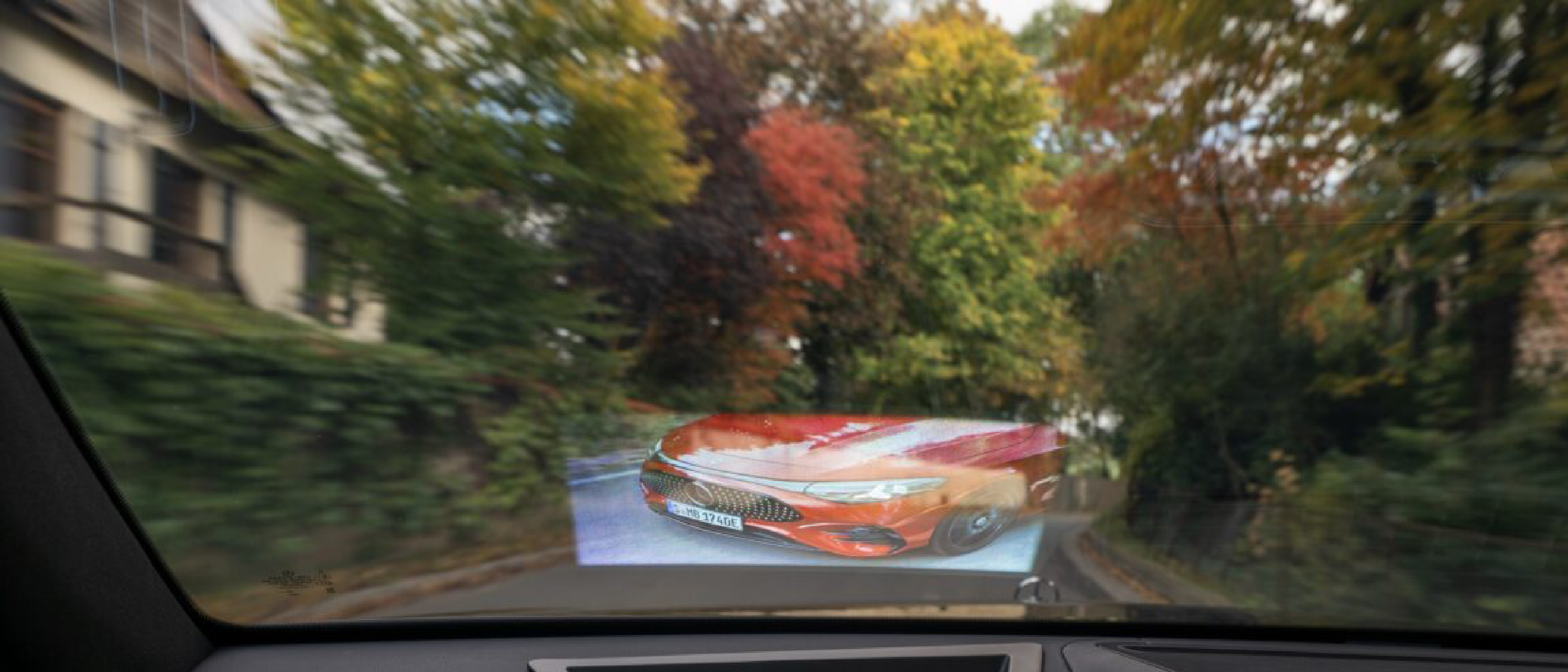
While the automaker has kept the exact technical specifications under wraps, the available information paints a picture of a display that projects three‑dimensional imagery onto the windshield, creating the illusion of a floating screen that hovers in the driver’s line of sight. Unlike conventional HUDs that render flat, monochrome symbols, this system leverages holographic wavefront reconstruction to generate depth cues and parallax, making virtual objects appear at varying distances.
Core Components
- Laser‑based Light Engine – A low‑power, eye‑safe laser source creates coherent light that can be modulated at high frequencies.
- Spatial Light Modulator (SLM) – This micro‑electromechanical device shapes the laser beam into the desired holographic pattern.
- Beam‑Combining Optics – A series of prisms and waveguides direct the modulated light onto a specific region of the windshield, where it interferes with ambient light to form the hologram.
- Eye‑Tracking Sensors – Integrated cameras monitor the driver’s eye position, adjusting the focal plane so the hologram remains crisp regardless of head movement.
User Experience
The result is a dynamic, depth‑rich overlay that can display navigation arrows, speed limits, and media controls without the need to glance down at a physical screen. Because the hologram occupies a virtual space, it can be resized or repositioned in real time, adapting to driving conditions or user preferences. The system also supports gesture interaction; a light tap on the windshield can acknowledge a command, while a swipe can scroll through menus.
Mercedes‑Benz’s test journalists, including the team from Ars Technica, were flown from Los Angeles to Stuttgart to experience the prototype. The outlet emphasized its editorial independence, noting that the trip was fully covered by the automaker but that no paid content was accepted. Their hands‑on impression highlighted the display’s clarity in bright daylight and the absence of visual fatigue after extended use—critical factors for any HUD technology.
Why It Matters for Luxury and Mainstream Vehicles
Redefining Luxury
Historically, the presence of a large, high‑resolution screen has been a status symbol. A vehicle’s interior tech suite often signals the price tier: the more screens, the higher the perceived value. However, Mercedes‑Benz argues that “screens can only get so big.” By moving the visual interface from a physical panel to a holographic projection, the brand can deliver a premium experience without expanding the dashboard footprint. This aligns with the luxury market’s shift toward minimalist elegance—where the absence of clutter is itself a statement of opulence.
Trickle‑Down Potential
Luxury innovations rarely stay confined to the top tier. Historically, features such as adaptive cruise control, lane‑keeping assist, and even touch‑screen infotainment migrated to mainstream models after a few years. The holographic HUD could follow a similar path:
- Cost‑effective manufacturing – As laser and SLM production scales, component prices are expected to drop.
- Software modularity – The display logic is software‑driven, allowing OEMs to license the stack without redesigning hardware.
- Regulatory acceptance – If safety agencies certify holographic HUDs as non‑distracting, they become a viable option for mid‑range vehicles.
Competitive Landscape
Mercedes‑Benz is not alone in pursuing immersive cockpit experiences. Chinese manufacturers have already announced Apple Wallet car‑key integration (see Chinese Auto Giant Moves to Apple Wallet Car Keys ), indicating a broader industry push toward seamless digital interaction. Meanwhile, the rise of USB‑C connectivity in smartphones (explored in USB‑C on Your Phone: More Than Just Charging and Data ) hints at a future where vehicles become extensions of personal devices, further justifying a HUD that can display phone notifications without a physical screen.
Industry Impact and Competitive Landscape
Shifting Design Paradigms
Automotive designers have long grappled with the trade‑off between information density and driver focus. The holographic HUD offers a middle ground: critical data is presented directly in the driver’s line of sight, while secondary information can be hidden or summoned on demand. This could lead to a new design language where the dashboard becomes a clean glass surface, and the windshield doubles as an interactive canvas.
Supplier Ecosystem
The technology relies heavily on optical components and high‑speed processors. Companies specializing in laser diodes, such as **
Supplier Ecosystem
The technology relies heavily on optical components and high‑speed processors. Companies specializing in laser diodes, such as II‑VI Incorporated, Coherent, and NKT Photonics, are already supplying the low‑power, eye‑safe lasers needed for the holographic wavefront generation. Meanwhile, spatial light modulator (SLM) manufacturers like Holoeye, Hamamatsu, and Meadowlark Optics provide the micro‑electromechanical devices that shape the laser beam into the precise holographic patterns required for a stable, high‑resolution image.
On the optics side, Lumentum and Thorlabs are contributing custom waveguide and prism assemblies that route the modulated light onto the windshield without introducing distortion. The eye‑tracking subsystem draws on expertise from automotive‑grade camera makers such as Infineon and Sony, whose sensors can operate reliably across the wide temperature range found in a vehicle cabin.
Finally, the software stack that translates vehicle data into holographic content is being co‑developed with firms like Qt Automotive Suite and Microsoft’s Azure Mixed Reality platform, ensuring that the display can render 3‑D graphics in real time while staying compliant with automotive safety standards (ISO 26262, functional safety level D).
Technical Hurdles and Safety Considerations
While the prototype demonstrated impressive clarity, several engineering challenges remain before mass production:
| Challenge | Description | Potential Mitigation |
|---|---|---|
| Ambient Light Interference | Bright sunlight can wash out the holographic image. | Adaptive brightness control and dynamic wavefront adjustment using real‑time photometric sensors. |
| Eye‑Safety Regulations | Laser emissions must stay below Class 1 limits for prolonged exposure. | Use of diffused, low‑power lasers combined with automatic shut‑off when eye‑tracking detects prolonged stare. |
| Latency | Any lag between driver input and hologram update can be disorienting. | Integration of automotive‑grade GPUs (e.g., NVIDIA DRIVE AGX) to keep rendering latency under 20 ms. |
| Windshield Compatibility | Not all glass compositions support the required waveguide coupling. | Collaboration with glass manufacturers (e.g., Pilkington, AGC) to embed a thin, transparent waveguide layer during production. |
| Cost of SLMs | High‑resolution SLMs are currently expensive. | Leveraging economies of scale as SLMs become common in AR/VR headsets and consumer electronics. |
Mercedes‑Benz’s engineering team is already testing mitigation strategies in a series of on‑road trials across Europe and North America. Early data suggests that the system can maintain a minimum contrast ratio of 12:1 even under direct sunlight, meeting the visibility thresholds set by the European Union’s Regulation (EU) 2022/123 for HUDs.
Market Outlook and Timeline
Mercedes‑Benz has not announced a concrete launch date, but insiders indicate that a limited‑edition “Vision HUD” will appear on the 2027 S‑Class facelift, with broader rollout across the EQ electric line by 2028. Pricing is expected to be positioned as a premium option—roughly $2,500–$3,500 on top of the vehicle’s base price—mirroring the cost structure of current augmented‑reality head-up displays (e.g., BMW’s “AR‑HUD”).
Given the typical technology trickle‑down curve in the automotive sector (≈ 3–5 years from flagship to mid‑range), we can anticipate that mid‑tier luxury brands such as Audi and Lexus will introduce comparable holographic HUDs by the early 2030s, while mainstream manufacturers (Toyota, Hyundai) may offer scaled‑down versions as part of their 2032 model year refreshes.
Competitive Landscape Recap
| Manufacturer | Current HUD Offering | Holographic Roadmap |
|---|---|---|
| Mercedes‑Benz | Conventional monochrome HUD (S‑Class, EQ) | Full‑color holographic HUD (2027‑2028) |
| BMW | AR‑HUD with 3‑D navigation cues | Prototype holographic display (rumored 2029) |
| Audi | Virtual Cockpit with OLED panels | Exploring laser‑based holography (pilot 2029) |
| Toyota | Standard HUD on select models | Partnership with laser‑diode supplier for holography (2029‑2030) |
| Hyundai | “Digital Cluster” with HUD overlay | Expected holographic integration via joint venture (2031) |
Conclusion
The shift from flat, touch‑enabled panels to holographic projections marks a pivotal moment in automotive user‑interface design. By projecting information directly into the driver’s line of sight with depth cues and gesture control, Mercedes‑Benz is not merely adding another screen—it is redefining the very concept of a cockpit. If the early trials hold true, the technology promises to:
- Free up physical space in the cabin, allowing designers to pursue cleaner, more minimalist interiors.
- Reduce driver distraction by keeping essential data within the natural field of view.
- Create a scalable platform that can eventually trickle down to non‑luxury segments, much like adaptive cruise control did a decade ago.
As the automotive industry continues to converge with consumer electronics, the holographic HUD could become the new baseline for in‑car interaction—turning the windshield into a living canvas that adapts to the driver’s needs in real time. The next time you ask yourself, “What’s next?” the answer may be floating right in front of you.
FAQ
Q: Will the holographic HUD work at night? A: Yes. The system automatically adjusts the hologram’s brightness and contrast based on ambient light sensors, ensuring a comfortable view without glare.
Q: Is the holographic display compatible with existing infotainment systems? A: Mercedes‑Benz is building the HUD as a software‑defined layer that pulls data from the vehicle’s CAN‑bus and Ethernet backbone, so it can integrate with current MBUX services and third‑party apps that support the open‑source Automotive Grade Linux (AGL) platform.
Q: Can the HUD be customized by the driver? A: Users will be able to select which data streams appear (navigation, speed, media, phone notifications) and adjust the virtual screen’s size and position via voice commands or the central touchscreen.
Q: How does the system handle driver fatigue? A: Eye‑tracking sensors monitor blink rate and gaze stability. If signs of fatigue are detected, the HUD can issue subtle visual cues (e.g., dimming the display, flashing a reminder) and suggest a rest break.
Q: Will the holographic HUD increase the vehicle’s power consumption? A: The laser engine and SLM draw roughly 15 W in active mode, which is comparable to a conventional LED backlight. The impact on overall vehicle range, especially in electric models, is expected to be negligible (< 0.5 % of battery capacity per 100 km).
Q: Are there any privacy concerns with the eye‑tracking cameras? A: All eye‑tracking data is processed locally within the vehicle’s secure ECU and is not transmitted to external servers unless the driver explicitly enables cloud‑based services. Mercedes‑Benz follows GDPR‑compliant data handling practices.
For more updates on automotive UI innovations, stay tuned to our Hardware category.
Source: Original Article