







Background and Strategic Context
The AI Summit in San Francisco has become a de‑facto arena where national leaders and technology giants negotiate the next wave of artificial‑intelligence development. This year’s gathering was marked by an unprecedented diplomatic‑business convergence: South Korean President Jae Myung Lee sat down with Jensen Huang, founder and CEO of NVIDIA, alongside top executives from SK Group, SK hynix, SK Telecom, and academic heavyweights from KAIST.
South Korea’s ambition to transition from a manufacturing powerhouse to an AI‑centric economy is driven by three converging forces:
- Talent concentration – KAIST consistently ranks among the world’s top AI research universities, supplying a pipeline of PhDs and engineers.
- Hardware depth – SK hynix’s leadership in memory technologies (HBM, DDR) gives the nation a natural advantage in AI compute.
- Policy alignment – The Korean government has earmarked billions of dollars for AI R&D, tax incentives for AI startups, and a national AI strategy that mirrors the U.S. and China playbooks.
By aligning these assets with NVIDIA’s full‑stack AI platform, Korea aims to become a “global AI innovation hub” that can attract both venture capital and multinational R&D centers.
Key Announcements: Joint KAIST‑NVIDIA Lab
What Was Signed
- Parties – NVIDIA and KAIST’s Kim Jaechul Graduate School of AI.
- Location – Seoul campus, with dedicated GPU clusters and cloud‑edge testbeds.
- Mission – Accelerate research in agentic AI, a sub‑field focused on autonomous decision‑making agents that can plan, reason, and act with minimal human oversight.
Technical Components
| Component | NVIDIA Contribution | KAIST Contribution |
|---|---|---|
| Full‑stack AI expertise | CUDA, cuDNN, TensorRT, DGX systems | Curriculum design, research supervision |
| Nemotron open models | Access to open‑source large language models (LLMs) optimized for Korean language and multimodal tasks | Fine‑tuning, evaluation on Korean datasets |
| AI Cloud partner computing | NVIDIA AI Cloud (NVAIR) credits, scalable inference pipelines | Real‑world deployment scenarios (smart cities, healthcare) |
| Scientific talent | Mentorship, joint PhD programs | Faculty expertise in reinforcement learning, robotics |
The partnership is notable as the first joint AI lab between a Korean university and any global technology company, setting a precedent for future academia‑industry collaborations.
Why It Matters
- Accelerated model localization – Nemotron’s open models can be adapted to Korean linguistic nuances faster than building a model from scratch.
- Talent retention – Korean researchers gain direct exposure to cutting‑edge NVIDIA hardware, reducing brain drain to Silicon Valley.
- Ecosystem ripple effect – Startups in Seoul can now prototype on DGX‑A100 clusters without prohibitive capital expenditure.
For a broader view of how open‑model ecosystems are reshaping AI, see the recent coverage of Claude’s Voice Mode upgrade: https://ltdeveloperblogs.github.io/posts/claude-voice-mode-gains-opus-and-sonnet-model-support .
Expanded SK Collaboration and Memory Co‑Development
June‑Announced Expansion
In June, SK Group and NVIDIA disclosed a co‑development program for memory modules tailored to NVIDIA’s AI platforms. The initiative targets three application pillars:
- AI Infrastructure – High‑bandwidth memory (HBM) optimized for large‑scale training clusters.
- Personal AI – Low‑latency, power‑efficient DRAM for edge devices such as AI‑enabled smartphones and wearables.
- Physical AI – Rugged memory solutions for robotics, autonomous vehicles, and industrial IoT.
SK Telecom’s Infrastructure Blueprint
During the same summit, SK Telecom outlined a roadmap to build a national AI infrastructure layer that will underpin:
- Physical AI – Real‑time perception stacks for autonomous drones and warehouse robots.
- Robotics – Cloud‑native orchestration of robot fleets using NVIDIA’s Isaac platform.
- Emerging domains – Quantum‑ready AI pipelines and neuromorphic research.
The synergy between SK’s telecom backbone, SK hynix’s memory, and NVIDIA’s compute stack creates a vertically integrated stack that could rival the U.S. and Chinese AI supply chains.
Competitive Landscape
China’s aggressive chip race, highlighted in the organ‑transplant‑chip article, underscores the strategic importance of memory technology: https://ltdeveloperblogs.github.io/posts/the-download-an-organ-transplant-breakthrough-and-homegrown-chinese-chips . Korea’s joint effort with NVIDIA positions it to compete on both performance and energy efficiency fronts.
Technical Implications for Agentic AI and Infrastructure
Agentic AI Defined
Agentic AI refers to systems capable of goal‑directed behavior without continuous human prompting. Core technical challenges include:
- Long‑term planning – Hierarchical reinforcement learning.
- Safety and alignment – Reward modeling that respects ethical constraints.
- Multimodal perception – Integration of vision, language, and sensor data.
The KAIST‑NVIDIA lab will leverage Nemotron as a foundation, adding Korean‑language corpora and domain‑specific reinforcement signals. By coupling this with NVIDIA’s Isaac Sim and Omniverse, researchers can simulate complex environments (e.g., smart factories) before real‑world deployment.
Memory Co‑Design Benefits
Memory bandwidth directly influences the training throughput of large transformer models. SK hynix’s upcoming HBM‑3E modules, co‑engineered with NVIDIA’s DGX systems, promise:
- Up to 30 % reduction in training time for 175‑billion‑parameter models.
- Lower power per FLOP, crucial for sustainable AI compute.
- Edge‑optimized LPDDR5X variants for on‑device inference, enabling personal AI assistants that run locally.
These hardware advances also address concerns raised by platforms like YouTube about AI‑generated content quality and moderation, discussed in: #link-removed
ouTube’s new AI policies for creators.
Policy and Geopolitical Considerations
South Korea’s AI push is not occurring in a vacuum. The country’s strategic positioning between the U.S. and China presents both opportunities and challenges:
- U.S. Alignment – By deepening ties with NVIDIA, Korea aligns itself with the U.S. AI ecosystem, gaining access to cutting-edge hardware and software while mitigating risks of export controls on advanced semiconductors.
- China Competition – Korea’s memory dominance (SK hynix controls ~50% of the global HBM market) makes it a critical player in the AI supply chain, but also a target for Chinese industrial espionage and trade pressures.
- Regulatory Harmonization – Korea’s AI Act, modeled after the EU’s AI Act, seeks to balance innovation with ethical safeguards. The KAIST-NVIDIA lab will serve as a testbed for compliance with these emerging regulations, particularly in high-risk domains like healthcare and autonomous systems.
President Lee’s presence at the summit underscores the government’s commitment to treating AI as a national priority, akin to the semiconductor initiatives of the 1980s and 1990s. This alignment between policy, industry, and academia mirrors the “triple helix” model that propelled Israel and Taiwan into tech leadership.
Event Highlights: Dinner and Beyond
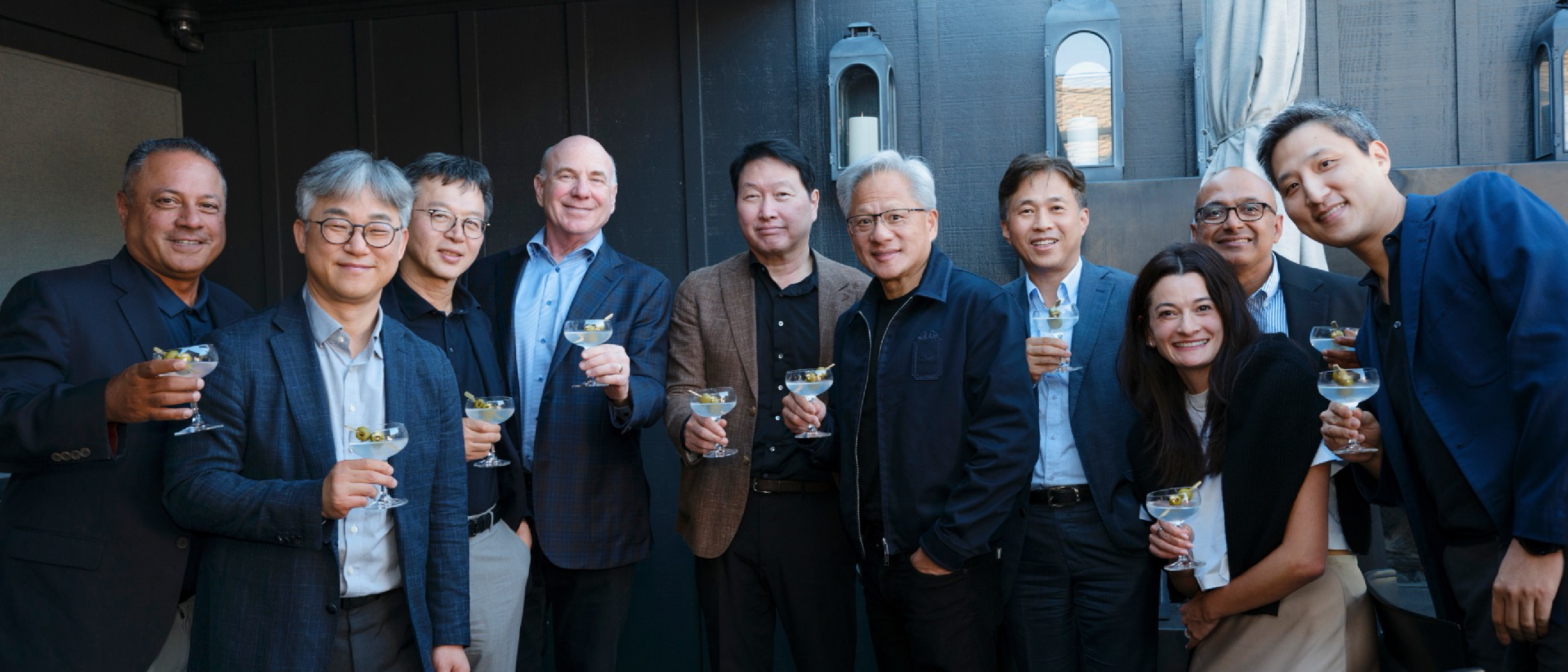
The Woodside Dinner
The Thursday evening gathering at a private estate in Woodside, California, was more than a celebratory dinner—it was a symbolic handoff of the AI baton. Key moments included:
- Jensen Huang’s Toast – Huang emphasized NVIDIA’s long-term commitment to Korea, framing the partnership as a “fusion of Korean precision and NVIDIA’s innovation velocity.”
- Chey Tae-won’s Vision – The SK Group chairman outlined a 10-year roadmap for AI-driven industrial transformation, from smart factories to AI-powered healthcare diagnostics.
- SK hynix’s Demo – A live demonstration of HBM-3E memory modules running a 100-billion-parameter LLM showcased the tangible progress of the co-development program.
- SK Telecom’s AI Cloud – A preview of the company’s AI infrastructure layer, which will integrate NVIDIA’s DGX systems with SK’s 5G/6G networks to enable real-time edge AI applications.
The dinner also served as a networking hub, with Korean startups and U.S. venture capitalists exploring potential collaborations. Reports suggest that several term sheets for AI-focused Series A rounds were informally discussed.
Ongoing Summit Meetings
The AI Summit continued with high-level bilateral meetings:
- President Lee and Jensen Huang – Discussed potential U.S.-Korea AI research initiatives, including joint funding for AI safety research and talent exchange programs.
- Korean CEOs and U.S. Tech Leaders – Explored partnerships in AI hardware (e.g., NVIDIA-SK hynix joint ventures), AI software (e.g., Korean startups leveraging NVIDIA’s AI Cloud), and AI applications (e.g., smart city pilots in Seoul and Busan).
- KAIST and U.S. Universities – Signed MOUs with Stanford, MIT, and UC Berkeley to establish joint PhD programs and research centers focused on agentic AI and robotics.
Challenges and Roadblocks
Despite the optimism, several challenges loom:
- Talent Shortage – Korea’s AI talent pool, while strong, is insufficient to meet the demands of its ambitious roadmap. The KAIST-NVIDIA lab aims to address this by training 500 AI engineers annually, but competition with the U.S. and China for top researchers remains fierce.
- Supply Chain Risks – Korea’s reliance on Taiwanese foundries (TSMC) for advanced logic chips exposes it to geopolitical risks. SK hynix’s memory leadership mitigates this, but a diversified supply chain is critical.
- Ethical and Regulatory Hurdles – Agentic AI systems raise concerns about autonomy, accountability, and bias. The KAIST-NVIDIA lab will need to proactively address these issues to avoid regulatory backlash.
- Global Competition – The U.S., China, and the EU are all investing heavily in AI. Korea’s success hinges on its ability to carve out niche leadership in memory-optimized AI and physical AI applications.
Conclusion: Korea’s AI Moment
The AI Summit in San Francisco marked a pivotal moment for South Korea’s AI ambitions. By forging deep partnerships with NVIDIA, SK Group, and KAIST, Korea is positioning itself as a global AI innovation hub—one that leverages its strengths in memory, talent, and policy to compete with the U.S. and China.
The KAIST-NVIDIA joint lab is more than a research initiative; it is a proof of concept for Korea’s ability to integrate global technology with local expertise. If successful, it could serve as a blueprint for other nations seeking to build AI ecosystems without relying solely on domestic resources.
For businesses, investors, and policymakers, the message is clear: Korea is open for AI business. The next decade will determine whether this strategy can deliver on its promise—or whether Korea will remain a supporting player in the global AI race.
FAQ
1. What is agentic AI, and why is it significant for Korea?
Agentic AI refers to systems capable of autonomous decision-making, planning, and action without continuous human input. For Korea, this technology is critical for applications like smart manufacturing, autonomous logistics, and healthcare diagnostics. The KAIST-NVIDIA lab’s focus on agentic AI aligns with Korea’s industrial strengths in robotics and automation.
2. How does SK hynix’s memory co-development with NVIDIA benefit AI?
Memory bandwidth is a bottleneck for AI training and inference. SK hynix’s HBM-3E modules, co-designed with NVIDIA, promise 30% faster training times and lower power consumption for large models. This is particularly valuable for edge AI devices, where efficiency is paramount.
3. What are the risks of Korea’s AI strategy?
Key risks include:
- Talent shortages: Korea’s AI workforce is smaller than the U.S. or China’s.
- Geopolitical tensions: Korea’s reliance on U.S. technology and Taiwanese foundries could be disrupted by trade conflicts.
- Regulatory uncertainty: Korea’s AI Act may impose compliance burdens on startups and enterprises.
4. How does this partnership compare to China’s AI efforts?
China’s AI strategy is more state-driven, with heavy investments in domestic chip manufacturing (e.g., Huawei’s Ascend chips) and AI applications like surveillance. Korea’s approach is hybrid, combining private-sector innovation (SK, NVIDIA) with government support. While China has scale, Korea offers precision—particularly in memory and hardware-software co-design.
5. What’s next for Korea’s AI ecosystem?
Key milestones to watch:
- 2025: Launch of the KAIST-NVIDIA lab’s first agentic AI prototypes.
- 2026: SK Telecom’s AI infrastructure layer goes live, enabling real-time edge AI applications.
- 2027: Expansion of the NVIDIA-SK memory co-development program to include next-gen HBM-4 modules.
- 2030: Korea aims to be among the top 3 global AI hubs, measured by R&D output, startup activity, and industrial adoption.
Source: Original Article