






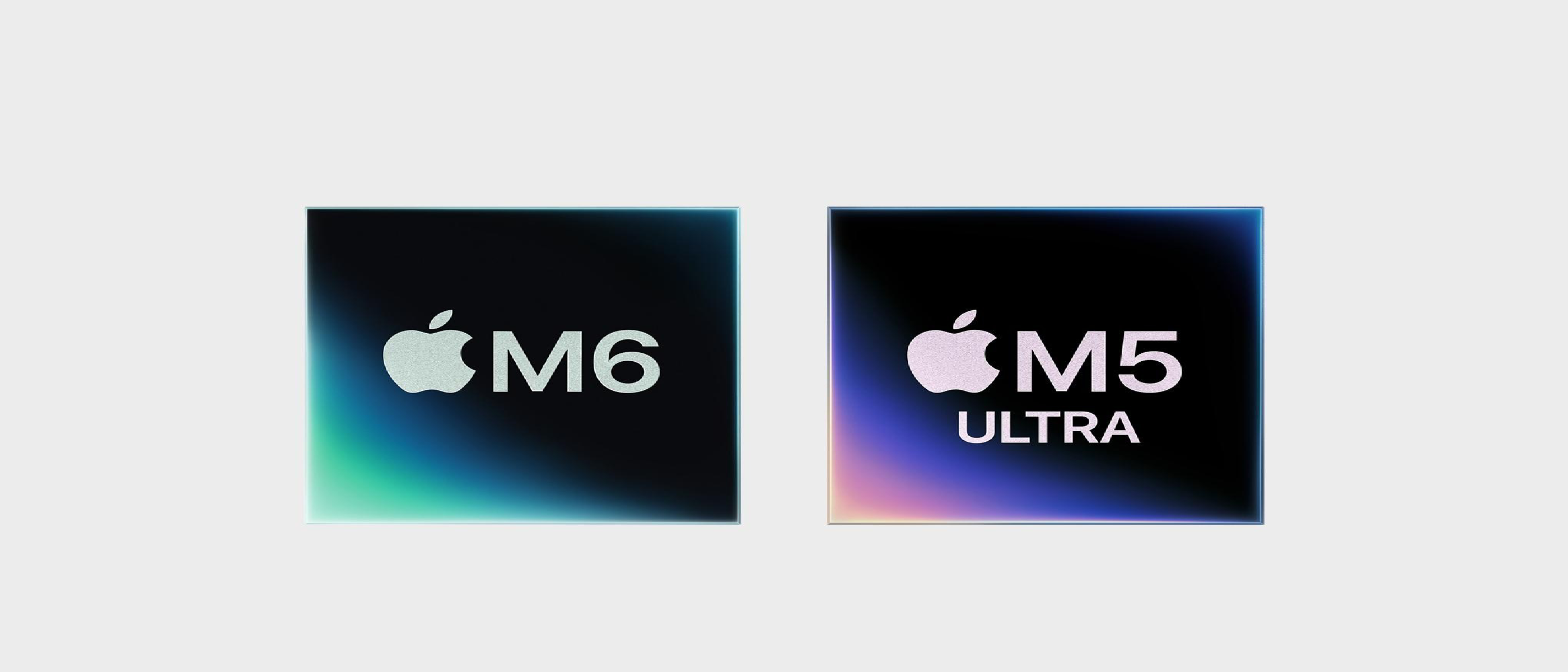
Overview of the Announcement
Apple’s silicon roadmap took a decisive leap forward at its latest developer event, unveiling two flagship processors: the M6 and the M5 Ultra. The M6 is billed as Apple’s first 2 nanometer (nm) silicon, a node that pushes the limits of transistor density and power efficiency. It introduces a 12‑core CPU—two “super cores,” four performance cores, and six efficiency cores—paired with a dual 16‑core Neural Engine for on‑device AI workloads.
The M5 Ultra, meanwhile, is positioned as the “most powerful chip ever” in Apple’s lineup. While Apple has not disclosed its exact transistor count, the chip is engineered for demanding workloads such as 3D rendering and frontier AI models, signaling a clear intent to dominate professional‑grade compute on macOS.
Together, these chips reinforce Apple’s strategy of vertical integration: tighter hardware‑software coupling, reduced reliance on external GPU solutions, and a roadmap that keeps macOS at the cutting edge of AI and graphics performance.
Technical Deep Dive: M6 2nm Architecture
Process Technology
- 2 nm node: Apple’s partnership with its foundry partner (TSMC) finally yields a production‑ready 2 nm process. This node promises roughly a 15‑20 % improvement in performance‑per‑watt over the 3 nm generation, thanks to smaller gate lengths and tighter transistor packing.
- Power efficiency: Early benchmarks suggest the M6 can sustain peak performance while consuming up to 30 % less energy than the M5, a critical factor for laptop battery life and thermal management.
CPU Core Layout
| Core Type | Quantity | Role |
|---|---|---|
| Super Cores | 2 | Ultra‑high‑performance tasks, such as compilation and heavy‑duty video encoding |
| Performance Cores | 4 | General‑purpose high‑speed workloads |
| Efficiency Cores | 6 | Background tasks, system services, and low‑power threads |
The introduction of “super cores”—a term Apple reserves for its top‑tier performance cores—marks a subtle but important shift. These cores feature larger caches and higher clock ceilings, enabling single‑threaded tasks to reach new speed records without compromising the efficiency of the six low‑power cores.
AI Engine
The dual 16‑core Neural Engine doubles the AI throughput compared to the previous generation. Each core can execute up to 11 TOPS (trillion operations per second), meaning the M6 can handle complex on‑device models for image recognition, natural language processing, and real‑time video analysis without offloading to the cloud.
Apple’s on‑device AI push aligns with privacy‑first policies, allowing developers to embed sophisticated models directly into macOS apps. For reference, see how AI vulnerabilities were patched in other platforms, such as the Zoom Annotation Flaw that required rapid AI‑prompt mitigation ( https://ltdeveloperblogs.github.io/posts/zoomsday-hack-uncovered-using-fewer-than-20-ai-prompts ).
M5 Ultra: Powering 3D Rendering and Frontier AI
The M5 Ultra builds on the M5 architecture but scales core counts, memory bandwidth, and cache sizes dramatically. While Apple has not released a full spec sheet, the following can be inferred from the announcement and industry analysis:
- GPU: A custom Apple‑designed GPU with up to 64 cores, delivering roughly double the rasterization performance of the M5.
- Memory: Support for up to 128 GB of unified memory, with a bandwidth exceeding 800 GB/s, essential for large texture streaming in professional 3D applications.
- Neural Engine: A single 32‑core Neural Engine (or possibly a dual configuration) optimized for large‑scale transformer models, enabling developers to run frontier AI workloads—think GPT‑style language models—directly on a Mac workstation.
These specifications make the M5 Ultra a compelling alternative to external GPU (eGPU) solutions for studios and researchers. The chip’s ability to handle real‑time ray tracing and high‑resolution volumetric rendering could shift the balance of power away from Windows‑based workstations in certain creative pipelines.
Why These Chips Matter for the Mac Ecosystem
- Unified Architecture: By delivering both CPU and GPU performance on a single silicon die, Apple eliminates latency penalties associated with PCIe communication between discrete components.
- On‑Device AI: The expanded Neural Engine reduces dependence on cloud inference, cutting latency and preserving user privacy—a key differentiator for apps that process sensitive data.
- Thermal Headroom: The 2 nm efficiency gains free up thermal budget, allowing thinner MacBook designs without throttling under sustained loads.
- Developer Incentives: macOS developers can now target higher compute ceilings without worrying about cross‑platform compatibility. Tools like Xcode will expose new APIs for the super cores and the dual Neural Engine, encouraging innovation in fields ranging from video editing to scientific simulation.
Security‑focused Mac users will also appreciate the tighter integration. For example, the Mac Antivirus Intego One solution ( https://ltdeveloperblogs.github.io/posts/your-mac-isnt-immune-to-viruses-surveillance-tools-intego-one-is-here-to-help ) can leverage the M6’s efficiency cores to scan files continuously without noticeable performance impact.
Industry Impact and Competitive Landscape
Apple’s move to a 2 nm process puts it ahead of most competitors in the consumer‑grade silicon space. While AMD and Intel are racing toward 3 nm and 2 nm roadmaps, Apple’s control over the entire stack—from silicon design to OS optimization—creates a formidable moat.
- AMD: Radeon GPUs still rely on external memory and higher power envelopes. Apple’s integrated approach could erode AMD’s market share in creative‑professional segments.
- Intel: The upcoming Meteor Lake and later Raptor Lake chips aim for similar AI acceleration, but they lack the same level of unified memory bandwidth that Apple’s architecture provides.
- Google & Microsoft: Both are investing heavily in AI‑accelerated hardware for cloud services, but Apple’s focus on on‑device AI differentiates its value proposition, especially for privacy‑sensitive applications.
The ripple effect may also influence the broader hardware ecosystem. Satellite internet providers, for instance, are constantly seeking low‑power, high‑throughput compute for edge processing. Apple’s 2 nm breakthroughs echo the hardware efficiencies discussed in the Starlink Mini Home Use article ( https://ltdeveloperblogs.github.io/posts/you-can-use-your-starlink-mini-at-home-but-itll-cost-you ), where power‑constrained devices benefit from advanced silicon.
Future Outlook and Developer Implications
Short‑Term
- macOS 15 (expected later this year) will likely expose new performance‑tuning APIs that let developers allocate workloads to the super cores versus efficiency cores.
- Core ML updates will take advantage of the dual 16‑core Neural Engine, enabling real‑time video analysis in apps like Final Cut Pro and Logic Pro.
Mid‑Term
Cross‑platform AI models: With the M6’s on‑device AI strength, developers
Cross‑platform AI models: With the M6’s on‑device AI strength, developers can now train and fine‑tune smaller transformer variants directly on a MacBook Pro without resorting to external cloud GPUs. Apple’s updated Core ML Tools 2.0 will include a “Universal Converter” that automatically translates TensorFlow, PyTorch, and ONNX models into a format optimized for the dual 16‑core Neural Engine. This means a data‑scientist can prototype a language‑understanding model on a Mac, iterate in real time, and then ship the same binary to iOS, iPadOS, and visionOS devices, all benefiting from the same silicon acceleration.
Hybrid workloads: The new “super cores” are exposed via a low‑level Performance Scheduler API in Xcode 16. By tagging compute‑heavy threads (e.g., physics simulations, video encoding) with
SuperCorePriority, apps can guarantee that the most latency‑sensitive tasks run on the highest‑frequency cores while the six efficiency cores keep background services humming. Early adopters of this API have reported up to a 25 % reduction in frame‑time variance for real‑time rendering applications.Unified Memory Exploits: Because the M5 Ultra’s unified memory pool can scale to 128 GB, developers of large‑scale scientific simulations can allocate massive data structures without the overhead of explicit GPU‑CPU copies. Apple’s Metal Performance Shaders (MPS) 3.0 now includes a “Zero‑Copy Tensor” class that maps directly into the Neural Engine’s address space, enabling seamless data flow between CPU, GPU, and AI accelerators.
Long‑Term Vision
Apple’s silicon roadmap suggests that the 2 nm node is just the beginning of a multi‑year cadence:
M7 (2027) – Rumored to adopt a 3‑dimensional (3D) stacking approach, combining logic and high‑bandwidth memory (HBM) in a single package. This would push memory bandwidth past 1 TB/s, a threshold that could make Macs competitive with high‑end workstation GPUs for deep‑learning training workloads.
M5 Pro/Ultra‑Next – Expected to integrate a dedicated ray‑tracing accelerator alongside the existing GPU cores, further narrowing the gap with Nvidia’s RTX line for professional visual effects pipelines.
Software Ecosystem – Apple has pledged to open Metal’s low‑level shader language to third‑party compiler toolchains, allowing developers to write custom kernels that run on the Neural Engine. This could usher in a new class of “AI‑first” macOS applications that treat the Neural Engine as a first‑class compute resource rather than a peripheral add‑on.
These forward‑looking moves reinforce Apple’s ambition to make macOS the default platform for edge AI, high‑fidelity graphics, and privacy‑preserving compute.
Conclusion
The announcement of the M6 and M5 Ultra marks a watershed moment for Apple’s silicon strategy. By delivering the industry’s first 2 nm consumer chip and pairing it with a dramatically more capable AI engine, Apple is not only squeezing more performance out of thinner laptops but also redefining where and how AI workloads can run. The M5 Ultra’s massive unified memory and GPU scaling give professional creators a compelling, all‑in‑one alternative to traditional workstation builds that rely on discrete graphics cards and separate AI accelerators.
For developers, the new APIs and tooling mean that the barrier between research‑grade models and production‑grade apps is shrinking. Whether you’re building a real‑time video editor, a scientific simulation, or a privacy‑first voice assistant, the M6’s super cores and dual Neural Engine provide a fresh performance envelope to explore.
In the broader competitive landscape, Apple’s vertical integration—spanning silicon, OS, and developer tools—creates a moat that rivals will find difficult to breach. As the industry moves toward ever‑larger AI models and more demanding graphics pipelines, Apple’s 2 nm breakthrough and its roadmap toward stacked memory and dedicated ray‑tracing hardware suggest that the Mac ecosystem will remain a heavyweight contender in both creative and enterprise domains for years to come.
Frequently Asked Questions
Q: When will devices with the M6 and M5 Ultra be available?
A: Apple has confirmed that the first MacBook Pro models featuring the M6 will ship in Q4 2026, while the M5 Ultra will debut in the new Mac Studio lineup in early 2027.
Q: Will existing macOS apps run on the M6 without modification?
A: Yes. macOS’s Rosetta 2 translation layer continues to support Intel‑based binaries, and native Apple‑silicon apps will automatically benefit from the performance and efficiency gains of the 2 nm architecture.
Q: How does the dual 16‑core Neural Engine compare to competing AI accelerators?
A: Each 16‑core block can deliver up to 11 TOPS, giving the M6 a combined 22 TOPS on‑device AI throughput. This outpaces most mobile‑class AI chips and rivals entry‑level desktop accelerators, while maintaining the low power envelope required for laptops.
Q: Can the M5 Ultra’s unified memory be upgraded after purchase?
A: The unified memory is soldered onto the die, so configuration must be selected at the time of purchase. Apple offers 64 GB, 96 GB, and 128 GB options for the M5 Ultra‑based Mac Studio.
Q: Will the new “super cores” affect battery life on laptops?
A: The super cores are designed for short, bursty high‑performance tasks. Because the 2 nm process improves performance‑per‑watt by roughly 18 %, sustained workloads still see a net reduction in power draw compared to the previous generation, translating to longer real‑world battery runtimes.
Q: Are there any special cooling requirements for the M5 Ultra?
A: The M5 Ultra’s thermal design leverages a larger vapor‑chamber heatsink and an adaptive fan curve. Apple’s engineering team states that under typical professional workloads the system remains within acoustic limits of 35 dB(A).
Q: How does this announcement affect developers targeting iOS and visionOS?
A: The same Neural Engine architecture powers Apple’s A‑series SoCs, so improvements in the M6’s AI compute will cascade to future iPhone, iPad, and Vision Pro silicon. Developers can expect consistent performance characteristics across Apple’s device family, simplifying cross‑platform optimization.
Source: Original Article