







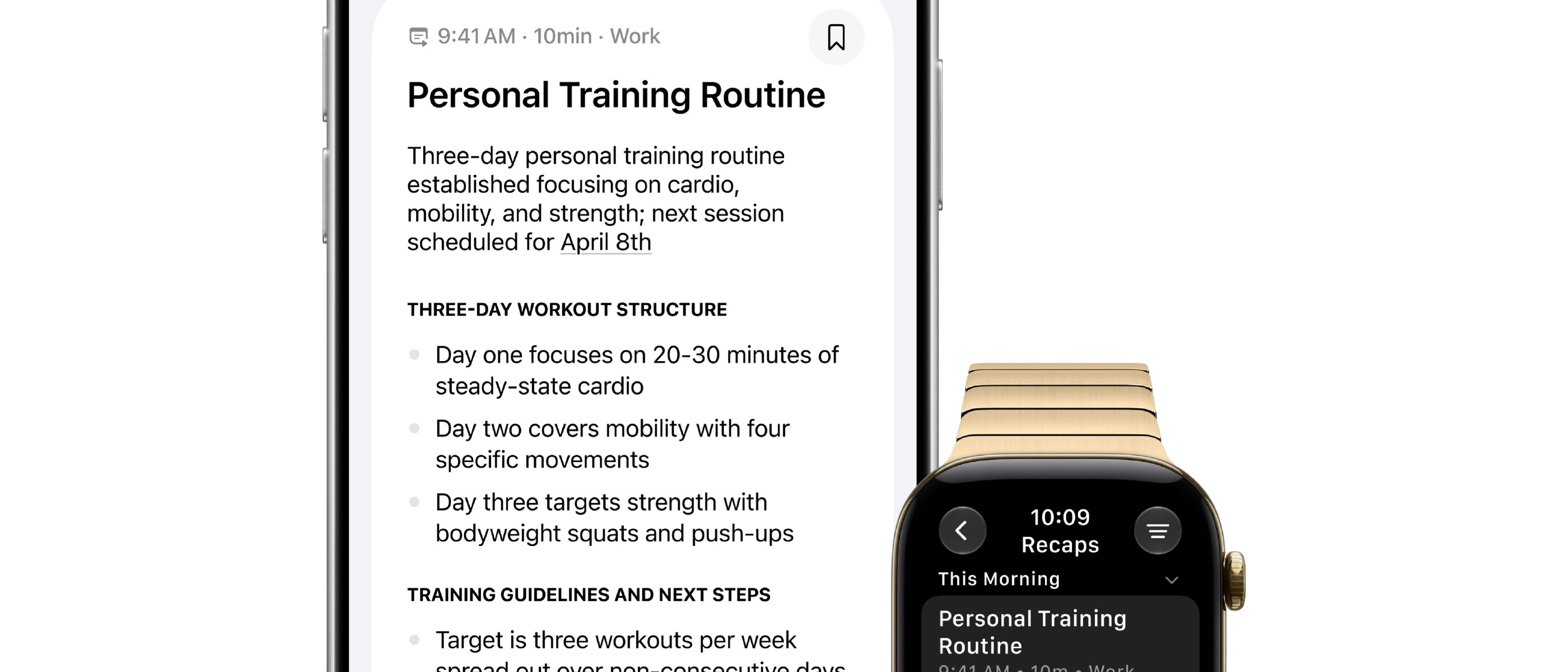
Overview of watchOS 27.3 Developer Beta
Apple unveiled the watchOS 27.3 developer beta today, marking the first public glimpse of the company’s “always‑on Audio Intelligence” platform for the Apple Watch. The beta rolls out automatically to registered developers, and the redesigned Health app is already available for testing. While the core operating system remains familiar, the new audio‑centric capabilities shift the watch from a passive notification hub to an active conversational assistant.
Key highlights include:
- Siri Recap – an ambient‑listening engine that captures snippets of nearby conversation and synthesizes a concise summary.
- Live Rewind – a 15‑second buffer that can be transcribed on demand, turning spoken moments into searchable text.
- Redesigned Health app – a fresh UI and expanded data visualizations, now testable in the beta.
- Expanded language support – nine languages, covering major global markets.
The beta is a developer‑only release; a public beta is expected later in the year, followed by a full rollout in early 2027.
Deep Dive into Audio Intelligence
Siri Recap: Ambient Listening in Practice
Siri Recap leverages the watch’s built‑in microphone and a low‑power DSP (digital signal processor) to continuously monitor ambient sound. When the system detects a conversational cue—such as a question or a decision point—it records a short audio segment, processes it locally, and generates a textual summary that appears on the watch face or within the Siri interface.
Why this matters:
- Contextual awareness – Users no longer need to manually invoke Siri to capture a thought; the watch can surface reminders (“Buy milk”) or action items (“Schedule a call with Alex”) automatically.
- Privacy‑first design – All processing occurs on‑device; only the final summary is stored, and users retain full control over what is retained or deleted.
- Battery efficiency – The DSP consumes a fraction of the main CPU’s power, preserving the watch’s typical 18‑hour battery life even with “always‑on” listening.
Live Rewind: Instant Transcription of Recent Audio
Live Rewind captures the last 15 seconds of audio detected by the watch’s microphone. When the user taps the new “Rewind” button, the segment is sent through Apple’s on‑device speech‑to‑text engine and displayed as a transcript. This feature is especially useful in noisy environments or when a spoken instruction is missed.
Technical considerations:
- Latency – Apple reports sub‑second turnaround from tap to transcript, thanks to the dedicated Neural Engine.
- Accuracy – Early developer feedback indicates a word‑error rate comparable to iPhone‑level dictation, even with the watch’s smaller microphone array.
- Use cases – Quick note‑taking during workouts, capturing a fleeting idea while on a run, or confirming a spoken command without pulling out an iPhone.
Both features rely heavily on Apple’s custom silicon (the S9 chip in the latest Apple Watch Series 9) and its machine‑learning accelerators. The integration showcases how wearables can host sophisticated AI workloads without compromising battery life.
Redesign of the Health App
The Health app receives a visual overhaul in watchOS 27.3. Apple’s design team introduced:
Modular dashboards – Users can pin their most‑
Modular dashboards – Users can pin their most‑used metrics—such as heart‑rate trends, sleep stages, or VO₂ max—directly to the watch face, creating a glance‑able health snapshot that updates in real time.
Dynamic visualizations – New graph styles (area, radial, and heat‑map) adapt to the watch’s limited screen real estate, automatically switching between compact and expanded views when the user rotates the Digital Crown.
Context‑aware shortcuts – Health‑related actions (e.g., “Log a water intake” or “Start a mindfulness session”) appear as quick‑access buttons when the watch detects relevant activity, such as a workout or a period of inactivity.
Enhanced data import – The beta adds support for third‑party health devices via the HealthKit API, allowing seamless syncing of blood‑glucose, blood‑pressure, and ECG data without leaving the watch.
Apple says the redesign is built on the same HealthKit framework introduced in watchOS 8, but the new UI leverages the S9 chip’s GPU to render smooth animations while staying within the watch’s power envelope.
Global Language Support
watchOS 27.3 expands its “always‑on” audio capabilities to nine languages, covering a broader swath of the global market:
| Language | Variants |
|---|---|
| English | US, UK, AU, CA |
| Chinese | Simplified, Traditional |
| French | — |
| Japanese | — |
| Korean | — |
| Norwegian | — |
| Portuguese | — |
| Spanish | — |
| Turki* | — |
*Apple lists “Turki” as a shorthand for Turkish in its internal documentation.
Developers can now localize Siri Recap and Live Rewind prompts using the new AudioIntelligence framework, which includes language‑specific acoustic models and on‑device vocabularies. Apple emphasizes that all language processing remains on‑device, preserving the privacy guarantees that have become a hallmark of its AI services.
Developer Guidance & Migration Path
Apple has published a set of migration notes for developers who want to integrate the new Audio Intelligence APIs:
- Add the
AudioIntelligenceentitlement to the app’sEntitlements.plist. - Request user consent via the new
AIPrivacyPromptUI, which explains ambient listening and offers granular controls (e.g., “Allow Recap only while charging”). - Implement the
AIRecapProviderprotocol to receive summarized text and optional action suggestions. - Use
AILiveRewindSessionto trigger on‑demand transcription; the API returns aTranscriptionResultobject with confidence scores and timestamps. - Test with the
watchOS‑27.3‑beta‑simulatorthat includes a synthetic microphone feed, allowing developers to validate edge cases such as background noise and overlapping speech.
Apple’s WWDC 2026 session “Audio Intelligence on watchOS” highlighted best practices for minimizing false positives, recommending developers respect the “conversation‑window” heuristic (i.e., only capture audio when a clear question or command is detected) and provide an easy “Forget this recap” button in the UI.
Privacy & Security Considerations
While the new features are powerful, Apple reiterates its commitment to privacy:
- On‑device processing – All audio analysis, transcription, and summarization happen within the watch’s Secure Enclave; no raw audio is ever uploaded to Apple servers unless the user explicitly opts in to share a recap.
- Ephemeral storage – Summaries are stored for a maximum of 30 days and are automatically purged unless the user pins them to the Health dashboard or saves them to the Notes app.
- Transparency dashboard – A new “Audio Intelligence” pane in Settings shows a timeline of when the microphone was active, what data was captured, and offers a one‑tap “Delete all” option.
These measures align with Apple’s broader privacy roadmap, which aims to keep “personal AI” confined to the user’s device.
Availability & Outlook
- Developer beta – Rolling out today to all registered developers via the Apple Developer portal.
- Public beta – Expected in Q4 2026, with a broader rollout slated for early 2027.
- Full release – Apple has hinted at a “watchOS 27.3 public launch” coinciding with the release of the next-generation Apple Watch (Series 10) in spring 2027.
Analysts predict that the always‑on audio layer could become a differentiator for wearables, positioning the Apple Watch as a true “conversation hub” rather than a passive notification device.
Conclusion
watchOS 27.3 marks a significant step forward for Apple’s wearable ecosystem, marrying low‑power hardware with sophisticated on‑device AI. By introducing Siri Recap and Live Rewind, Apple gives users a hands‑free way to capture thoughts, actions, and fleeting ideas without reaching for a phone. The redesigned Health app and expanded language support further cement the watch’s role as a global health and productivity companion. As the beta matures and developers begin to experiment with the new APIs, we can expect a wave of innovative apps that leverage ambient listening in ways that were previously impossible on a wrist‑worn device.
FAQ
Q: Will Siri Recap work when the watch is locked?
A: Yes. The ambient‑listening engine runs in the background even when the device is locked, but it only surfaces summaries after the user unlocks the watch or interacts with the Siri UI.
Q: Can I disable ambient listening entirely?
A: Absolutely. The new “Audio Intelligence” toggle in Settings lets you turn off both Siri Recap and Live Rewind. You can also disable them per‑app via the privacy permissions screen.
Q: Does Live Rewind store the captured audio?
A: The raw 15‑second audio buffer is kept in volatile memory only long enough to perform transcription. It is never written to persistent storage unless you explicitly save the transcript.
Q: How does the new Health app redesign affect existing data?
A: All existing health metrics are migrated automatically. The visual changes are purely cosmetic and do not alter the underlying data model.
Q: Will third‑party apps be able to access Siri Recap summaries?
A: Yes, but only with explicit user permission. Developers must request the AudioIntelligenceRead scope, and users can revoke access at any time from Settings.
Q: Is there any impact on battery life?
A: Apple states that the dedicated DSP and Neural Engine keep additional power draw under 2 % per day, which is negligible compared to typical watch usage patterns.
Source: Original Article